
Location guide
Buying Property in Comporta and the Alentejo Coast
A practical guide to the coastline south of Lisbon, covering Comporta, Carvalhal, Melides and Tróia, and continuing south through Porto Covo, Vila Nova de Milfontes and the wider Costa Vicentina.
- Beach access
- Nature and outdoors
- Peace and quiet
- Current
Quick overview
This is not a single property market. The northern end, around Comporta and Tróia, behaves very differently from the coastal towns further south, and the guide treats them separately throughout.
- Airports
- Lisbon (LIS) serves the northern half; Faro (FAO) can be closer for the southern Costa Vicentina
- Character
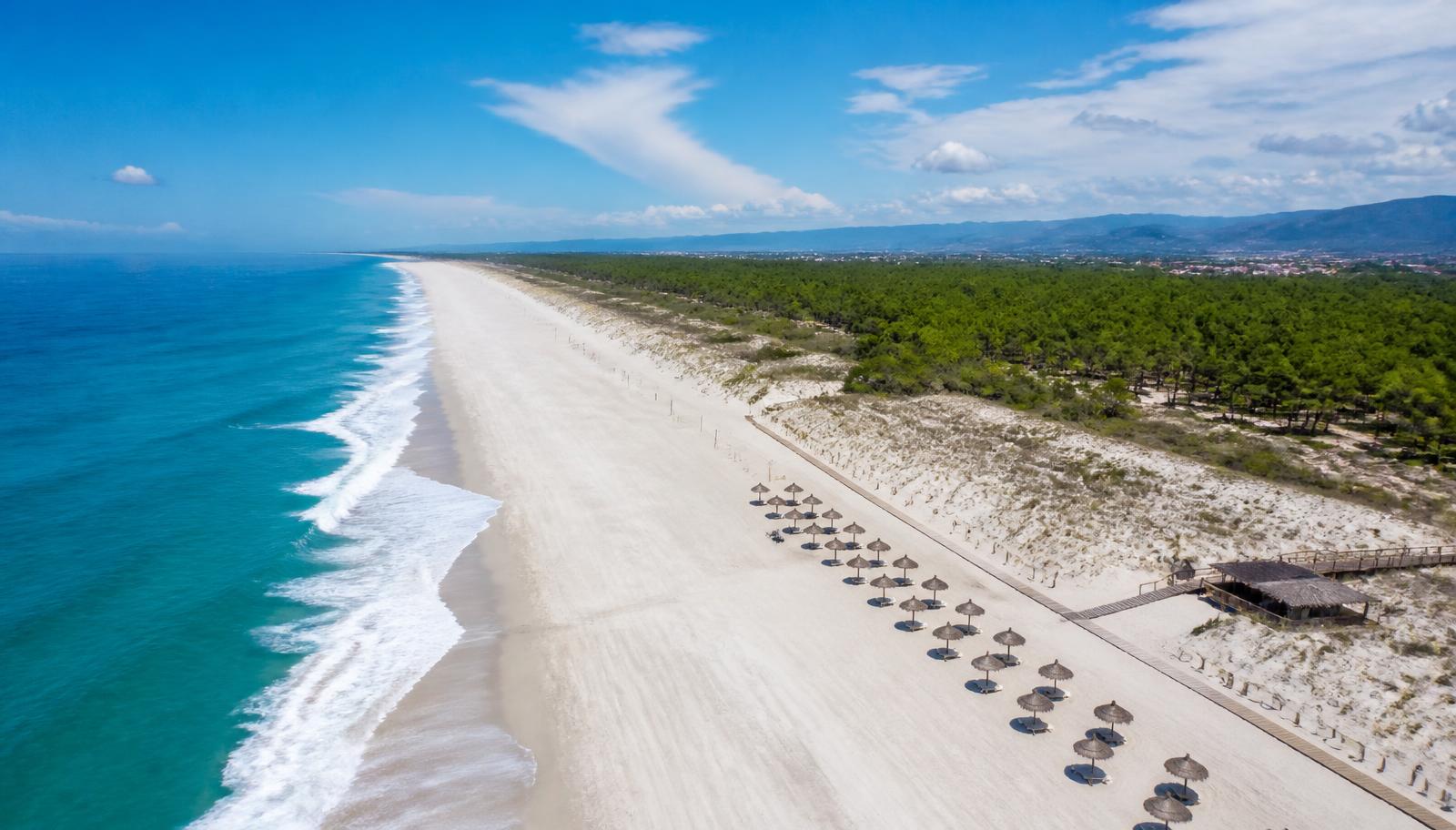
- Low-density coast: dunes, pine forest, rice fields, small towns and a few managed developments
- Property mix
- Villas, houses, land, new low-density schemes, and apartments or resort units around Tróia
- Getting around
- A car is effectively essential; public transport is limited across most of the region
- Seasonality
- Strongly seasonal in the smaller beach locations; Milfontes and Santiago do Cacém keep more year-round life
Quick comparison
A first, qualitative view of how the regions differ. Use the comparison tool for a version built around your own priorities.
- Airport access
- MediumAirport access: Medium
- Beach access
- Very HighBeach access: Very High
- City life
- Very LowCity life: Very Low
- Year-round living
- LowYear-round living: Low
- Access to healthcarePortugal offers established public and private healthcare. This indicator compares regional access to major hospitals, specialist services and higher-complexity care, rather than the overall quality of healthcare.
- MediumAccess to healthcare: Medium
- Seasonality
- HighSeasonality: High
- International community
- MediumInternational community: Medium
- New-build availability
- HighNew-build availability: High
- Resort availability
- MediumResort availability: Medium
- Golf access
- MediumGolf access: Medium
- Surf conditions
- HighSurf conditions: High
- Family lifestyle
- MediumFamily lifestyle: Medium
- Culture and restaurants
- MediumCulture and restaurants: Medium
- Remote working
- HighRemote working: High
- Lower price levels
- LowLower price levels: Low
- Nature and outdoors
- Very HighNature and outdoors: Very High
- International schools
- LowInternational schools: Low
- Rental demand
- MediumRental demand: Medium
- Peace and quiet
- Very HighPeace and quiet: Very High
- Public transport
- Very LowPublic transport: Very Low
- Non-car dependency
- Very LowNon-car dependency: Very Low
- SafetySafetySafety is rated at national level: Portugal ranks in the top tier of global peace and safety indices, so all regions are shown at the same 5-star level rather than being ranked against each other.
- Very HighSafety: Very High
Ratings are editorial indicators designed to help compare regions. They are not financial or investment rankings.
Who this region suits
The region attracts buyers who put coastline, space and privacy ahead of urban services. It is not presented here as the best region for any profile: it is a fit question.
Second-home buyers
Within roughly an hour to ninety minutes of Lisbon airport at the northern end, with a clear holiday-season rhythm.
Buyers prioritising nature and privacy
Protected coastline, low building density and large plots in parts of Comporta, Melides and the Costa Vicentina.
Premium villa and new-development buyers
Selected areas offer architect-led villas and low-density schemes, often sold before completion.
Resort and managed-property buyers
Tróia and some developments offer apartments and units inside managed or tourist structures.
Less suited to
Buyers who want city amenities, car-free living, international schooling on the doorstep or the same level of year-round services as Lisbon or Cascais.
Key areas
Accessibility, property types, development patterns, tourism intensity and planning context all change as you move south. Comporta is only one part of the wider coastal area, and comparing it with places further south is worthwhile before deciding.
Comporta
- Character
- Low-density coastal village surrounded by rice fields, dunes and pine forest
- Typical buyer
- Second-home buyers, premium villa buyers
- Seasonality
- High
- Lifestyle
- Beaches, nature, a small seasonal restaurant and hospitality scene
- Property mix
- Villas, plots and premium low-density developments
Carvalhal
- Character
- Coastal settlement a short drive south of Comporta
- Typical buyer
- Second-home and holiday buyers
- Seasonality
- High
- Lifestyle
- Direct beach access, quiet outside summer, car-based daily life
- Property mix
- Villas, houses and development schemes
Melides
- Character
- More rural, spread between a lagoon, farmland and the coast
- Typical buyer
- Privacy-focused buyers and land buyers
- Seasonality
- Medium
- Lifestyle
- Space, privacy, growing international interest, few services
- Property mix
- Villas, rural houses and land where planning must be checked closely
Tróia
- Character
- Peninsula facing Setúbal, reached by ferry or by road around the estuary
- Typical buyer
- Apartment and managed-property buyers
- Seasonality
- High
- Lifestyle
- Beaches, marina, golf, resort services concentrated in one area
- Property mix
- Apartments and resort-type units, often within condominium or tourist structures
Porto Covo
- Character
- Small traditional coastal town at the top of the Costa Vicentina
- Typical buyer
- Second-home buyers wanting a smaller scale
- Seasonality
- High
- Lifestyle
- Coves, cliff walks, a compact centre, very quiet winters
- Property mix
- Townhouses, smaller villas and apartments
Vila Nova de Milfontes
- Character
- Established coastal town at the mouth of the Mira river
- Typical buyer
- Buyers wanting a year-round local community
- Seasonality
- Medium
- Lifestyle
- Shops, schools, healthcare, river and ocean beaches, outdoor sport
- Property mix
- Houses, apartments and renovation property; a different mix from Comporta
Houses, land and new development
Villas, houses and land dominate; apartments and managed units are concentrated in specific places such as Tróia. Marketing descriptions of land or 'development potential' do not establish planning or building rights: those must be confirmed from the municipal position and the property's own documents.
Buying a home
Villas, houses, apartments in specific towns, and renovation property inland and along the coast.
Read the guideOff-plan and new build
Low-density schemes and villas sold before completion, mainly around Comporta, Carvalhal and Melides.
Read the guideResort and tourist units
Managed and tourist-registered units, most visible on the Tróia peninsula.
Read the guideLand and due diligence
Plots, rural land and building claims need licensing, registry and planning checks before any commitment.
Due diligence
Everyday life and year-round living
Daily life here is organised around the coast, distance and the seasons rather than around a town centre.
- Beaches are long, open and Atlantic; large stretches sit inside protected areas, which constrains building and shapes the character of the coast.
- Outdoor life dominates: walking, surfing, riding, cycling and the Rota Vicentina trails in the south.
- Plots are often large and neighbours distant, which delivers privacy but also means driving for almost everything.
- The hospitality offer around Comporta and Melides is seasonal and concentrated; several businesses close outside the summer months.
- Vila Nova de Milfontes and Santiago do Cacém carry more year-round services, including shops, schooling and healthcare, than the smaller beach settlements.
- International owners are present but dispersed; there is no single large expatriate community as in parts of the Algarve.
Access and transport
Access is not uniform across the region: the difference between the northern and southern ends is significant.
- From Lisbon
- Comporta, Carvalhal and Tróia are typically around an hour to ninety minutes by road via the A2 and A12; Melides adds time, and the Costa Vicentina towns are considerably further.
- Airports
- Lisbon is the practical gateway for the northern half. For Zambujeira do Mar and the southern Costa Vicentina, Faro can be a comparable or shorter drive.
- Tróia access
- The Setúbal–Tróia ferry shortens the trip from the north but runs to a timetable and can queue in summer; the road route around the estuary is the alternative.
- Public transport
- Limited across most of the region. Regional bus services connect the main towns with low frequencies; there is no useful local network in the smaller coastal areas.
- Car
- Assume a car is necessary, and in most locations more than one for a household using the property regularly.
New development
Parts of the region, particularly between Comporta and Melides, include new low-density projects and villas sold before completion, alongside resort-style development on Tróia. Confirm the construction licence, the completion timetable, the payment schedule, the guarantees and the finished specification before committing, and check what infrastructure and shared areas the developer is contractually obliged to deliver.
Buying off-planResort and managed property
Not every development here is a tourist resort, and the distinction matters. Establish whether a property is ordinary residential property, part of a registered tourist development, subject to a management contract, or bound by owner-use and rental arrangements. Around Tróia and some managed schemes these structures affect how freely the property can be used, let and resold.
Resort propertyPractical trade-offs
The region trades services and convenience for coastline, space and privacy.
Strengths
- An exceptional, largely protected coastline and natural environment
- Low-density character and a high degree of privacy
- Strong second-home appeal with an established seasonal rhythm
- Proximity to Lisbon in the northern part of the region
- Premium villa and low-density development options in selected areas
- A distinctive lifestyle that differs clearly from the Algarve or the Lisbon coast
Trade-offs
- High car dependency in almost every location
- Access varies significantly depending on exactly where you buy
- Marked seasonality in the smaller coastal settlements
- Fewer urban services, schools and specialist healthcare than Lisbon or Cascais
- Property and planning context varies sharply, especially for land
- Premium positioning in parts of Comporta, Carvalhal and Melides
- Resort and development structures can add contractual complexity
The buying process here
The purchase process is national, not regional: reservation, promissory contract (CPCV), due diligence and the deed follow the same sequence everywhere in Portugal. What changes locally is the property type, the documentation and the questions worth asking before you commit.
See how to buyCosts and taxes
IMT, Stamp Duty, notary and registration costs are set nationally and depend on the price, the property type and whether the home will be your main residence. Madeira and the Azores apply their own regional IMT tables.
If you are buying from abroad
A NIF, a Portuguese bank account or a payment route, and clear representation arrangements matter more than the region you choose. The country guides set out what changes depending on where you live.
Buyer GuidesCompare this region
See this region next to one or two others, weighted by the things that matter to you.
Compare with other regionsFrequently asked questions
Frequently asked questions
No. Comporta is one part of a much longer coastline. Lifestyle, accessibility, property types, density, services and development context all change as you move south towards Melides, Porto Covo, Vila Nova de Milfontes and the Costa Vicentina.
Comporta, Carvalhal and Tróia are usually around an hour to ninety minutes by road. Melides adds time, and the southern Costa Vicentina towns are considerably further, with Faro sometimes the more convenient airport.
In practice, yes. Public transport is limited across most of the region and daily life, beaches and services are spread out.
Sometimes, but a marketing description of building or development potential establishes nothing. Planning classification, licensing history and registry position must be verified for the specific plot before you commit.
It can be, but expect fewer year-round services than in a city. Vila Nova de Milfontes and the Santiago do Cacém area retain more everyday infrastructure than the smaller beach settlements.
Some are and some are not. Check whether the property is ordinary residential property or part of a registered tourist development with management, owner-use or rental arrangements attached.
Before you commit to a specific property
Once you have identified a property, the focus shifts from choosing a location to checking that particular transaction: title, licensing, charges, condominium documents and contract terms.
Legal services are provided by Valente Veiga & Associados.
How this guide is maintained
This guide uses stable, qualitative information about each area: geography, transport, property mix, services and lifestyle. It does not publish asking prices, transaction prices or rental yields.
Ratings are editorial indicators designed to help compare regions. They are not financial or investment rankings.
Content reviewed on 14 August 2026. Data version 2026.1.
Current
Related guides
How to buy property in Portugal
The full purchase process, from first offer to deed and registration.
Costs and taxes
IMT, Stamp Duty, notary, registration and the recurring costs of ownership.
Purchase Cost Calculator
Estimate the taxes and fees on a specific purchase price.
Buyer Guides
Country-specific guidance for buyers based outside Portugal.
This guide is general information about Portuguese regions and the property buying process. It is not legal, tax or investment advice, and it does not describe any specific property.
Ratings are editorial indicators designed to help compare regions. They are not financial or investment rankings.